Informa la Cancillería que el 1 de julio no será posible votar en Embajadas y Consulados de México
Comunicado No. 189.- La Secretaría de Relaciones Exteriores recuerda que el INE es un órgano autónomo y que, por tanto, el gobierno federal no participa en la organización del proceso electoral.
Aquellos mexicanos que se encuentran temporalmente fuera del país, no están en posibilidades de emitir su voto en el exterior.
28 de junio de 2018
La Secretaría de Relaciones Exteriores informa a los ciudadanos mexicanos que radican o se encuentran en el extranjero que el próximo domingo 1 de julio, conforme a las disposiciones electorales emitidas por el Instituto Nacional Electoral (INE), no será posible votar en las Embajadas y Consulados de México en el exterior.
La Cancillería recuerda que el INE es un órgano autónomo y que, por tanto, el gobierno federal no participa en la organización del proceso electoral. Con base en los Lineamientos para la Organización del Voto Postal de las Ciudadanas y los Ciudadanos Mexicanos Residentes en el Extranjero para los Procesos Electorales Federal y Locales 2017-2018 (emitidos por el INE) y demás disposiciones aplicables en la materia, la única forma de emitir el voto desde el exterior fue exclusivamente por la vía postal, previo registro ante el INE, mismo que concluyó el pasado 31 de marzo. Aquellos mexicanos que se encuentran temporalmente fuera del país, no están en posibilidades de emitir su voto en el exterior.
Por lo anterior, las representaciones de México en el exterior no están facultadas para recibir el voto durante la jornada electoral.
Detalles
Universidad Abierta y a Distancia de México (UnADM) 18-2-B2
La convocatoria a la Segunda Convocatoria 2018 está abierta.
Puedes registrarte como aspirante al proceso de admisión hasta el 22 de junio.
En esta modalidad educativa gratuita, los estudios se pueden realizar desde cualquier tableta, computadora o celular inteligente, con acceso a internet desde cualquier parte del mundo.
Para mexicanos que viven en el extranjero, están disponibles las Licenciaturas en:
This summer, the V&A will explore how Frida Kahlo (b. 1907), one of the most recognised and significant artists and women of the 20th century, fashioned her identity. Frida Kahlo: Making Her Self Up will be the first exhibition outside of Mexico to display her clothes and intimate possessions, reuniting them with key self-portraits and photographs to offer a fresh perspective on her compelling life story. We will present an unparalleled insight into Kahlo’s life revealing some objects that have never been on show before.
Working in close collaboration with Museo Frida Kahlo, we will display more than 200 objects from the Blue House. Kahlo’s personal items including outfits, letters, jewellery, cosmetics, medicines and medical corsets were discovered in 2004, 50 years after being sealed in the Blue House by her husband Diego Rivera, the Mexican muralist, following her death in 1954. Exploring Kahlo’s highly choreographed appearance and style, these include 22 distinctive colourful Tehuana garments; pre-Columbian necklaces that Frida strung herself; examples of intricately hand painted corsets and prosthetics which will be displayed alongside film and photography of the artist as a visual narrative of her life.
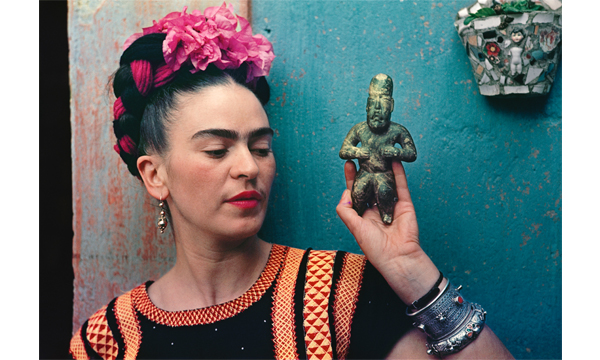
Included in Kahlo’s make-up selection is her eyebrow pencil ‘Ebony,’ still within its original packaging, which she used to emphasise her signature mono brow, a defining feature of her selfportraits and her favourite lipstick, Revlon’s ‘Everything’s Rosy’ and red nail varnish. Her vividly coloured cosmetics are striking in the celebrated portraits by photographer Nickolas Muray which show her wearing many of the clothes on display.
Claire Wilcox, Senior Curator of Fashion at the V&A and exhibition co-curator, said: “A countercultural and feminist symbol, this show will offer a powerful insight into how Frida Kahlo constructed her own identity. This show is a rare opportunity for visitors, offering unique access to an archive that has never left Mexico before.”
Circe Henestrosa, Head of the School of Fashion, LASALLE College of the Arts, Singapore and exhibition co-curator, said: "The exhibition will be a very personal experience with deeply individualised objects on show, particularly her corsets, which she decorated and painted, making them appear as though she had explicitly chosen to wear them. She included them in her art and in the construction of her style as an essential wardrobe item, almost as a second skin.”
The exhibition will reimagine Kahlo’s home, the Blue House, located in Coyoacán, on the outskirts of Mexico City, where she was born, lived and died. It will explore her life as a child with her family up to her marriage to Diego Rivera including an album of architectural church photographs by her German father Guillermo Kahlo, early paintings and photographs of Kahlo and Rivera together and with their influential circle of friends including Communist leader Leon Trotsky.
Kahlo empowered herself through her art and dress after suffering a devastating near-fatal bus crash at the age of 18, which rendered her bed-bound and immobilised for protracted periods of time. Self-portraiture became the primary focus of her art at this point and she began to paint using a mirror inset into the canopy of her four-poster bed. Much more was understood about Kahlo’s accident after the discovery of the objects in the Blue House. The exhibition will illuminate this story through items such as her medicines and orthopaedic aids. Kahlo possessed many supportive bodices and spine back braces and on display will be some of the corsets that she painted with religious and communist symbolism and tragic imagery relating to her miscarriages.
We will explore Kahlo’s Mexico and her sense of cultural pride following the Mexican Revolution (1910-20). An enthusiastic desire to embrace a national identity led to her interest in the art and traditions of indigenous people of the country. Kahlo used her striking appearance as a political statement, crafting her identity to reflect her own mestizo (mixed-race) identity and allegiance to Mexican identity.
Mexico flourished in the 1920s and 1930s as a liberal destination that attracted foreign artists, writers, photographers and documentary film makers, in what became known as the Mexican Renaissance. We will show photographs of traditions in clothing, architecture and the popular arts taken by Edward Weston and Tina Modotti in the 1920s that made an imprint on the Mexican imagination and its perception abroad. There will also be a wall of ex votos, from Kahlo and Rivera’s collection. These small votive paintings of popular art, made mainly in tin, offered to a saint or to a divinity in gratitude for the fulfillment of a miracle, informed Kahlo’s paintings.
On display will be garments from her collection: rebozos, a traditional Mexican shawl, huipiles, an embroidered square-cut top, enaguas and holanes, long skirts with flounces, and jewellery ranging from pre-Columbian jade beads to modern silverwork. A highlight will be the resplandor, a lace headdress worn by the women of the matriarchal society from the Isthmus of Tehuantepec region in Southern Mexico, paired with a self-portrait of Kahlo wearing it.
• The exhibition is accompanied by a new V&A publication and a series of related events, courses and creative workshops.
• Frida Kahlo: Making Her Self Up is co-curated by the V&A’s Claire Wilcox and independent curator Circe Henestrosa, with support from V&A research assistant, Ana Baeza Ruiz.
• Frida Kahlo: Making Her Self Up is designed by Tom Scutt and Gibson Thornley.
• The exhibition includes significant paintings from The Jacques and Natasha Gelman Collection of 20th Century Mexican Art and The Vergel Foundation
Corporate support for the V&A is more vital than ever. Please help us by acknowledging the exhibition sponsors Grosvenor Britain & Ireland and GRoW @ Annenberg.
About Grosvenor Britain & Ireland
With a host of retail streets set across the fashionable districts of Mayfair & Belgravia, Grosvenor Britain & Ireland is proud to partner with the V&A. As headline sponsor of this landmark exhibition we have drawn inspiration from this partnership to bring a modern echo of Frida’s impact to our London estate.
We will be activating the estate’s core destinations of Mayfair & Belgravia throughout the exhibition, starting with ‘Frida’s Belgravia in Bloom’ in May and continuing throughout thesummer with bespoke Frida-inspired products and experiences.
Grosvenor Britain & Ireland creates and manages high quality neighbourhoods that are great places to live, work and visit. We are part of Grosvenor Group, one of the world's largest privately-owned property businesses, which is active in more than 60 cities around the world.
Grosvenor.com | @Grosvenor_GBI and @Grosvenor_LDN on Twitter | @Belgravia_Ldn and
@Mayfair_Ldn on Instagram
About GRoW @ Annenberg
GRoW @ Annenberg is the philanthropic initiative led by Gregory Annenberg Weingarten, a Vice President and Director of the Annenberg Foundation. GRoW is dedicated to supporting humanitarian efforts across the globe as well as innovative projects in health, education, the arts and civic & cultural life.
For further PRESS information about Frida Kahlo: Making Her Self Up, please contact Kate
Morais in the V&A press office on 0044 (0) 20 7942 2503 or email Esta dirección de correo electrónico está siendo protegida contra los robots de spam. Necesita tener JavaScript habilitado para poder verlo. (not for Publication).
A selection of press images are available to download free of charge from pressimages.vam.ac.uk
Detalles
FRIDA ESCOBEDO TO DESIGN SERPENTINE PAVILION 2018
15 June – 7 October 2018
Press images at serpentinegalleries.org/press
The Mexican architect Frida Escobedo, celebrated for dynamic projects that reactivate urban space, has been commissioned to design the Serpentine Pavilion 2018. Harnessing a subtle interplay of light, water and geometry, her atmospheric courtyard-based design draws on both the domestic architecture of Mexico and British materials and history, specifically the Prime Meridian line at London’s Royal Observatory in Greenwich.
Escobedo (b. 1979, Mexico City) is the 18th and youngest architect yet to accept the invitation to design a temporary Pavilion on the Serpentine Gallery lawn in Kensington Gardens. This pioneering commission, which began in 2000 with Zaha Hadid, has presented the first UK structures of some of the biggest names in international architecture. In recent years, it has grown into a hotly anticipated showcase for emerging talent, from Sou Fujimoto of Japan to selgascano of Spain and Bjarke Ingels of Denmark, whose 2016 Pavilion was the most visited architectural and design exhibition in the world. Serpentine Galleries Artistic Director Hans Ulrich Obrist and CEO Yana Peel selected this year’s architect, with advisors David Adjaye and Richard Rogers. The Serpentine Pavilion 2018 is sponsored by Goldman Sachs in its fourth year of support.
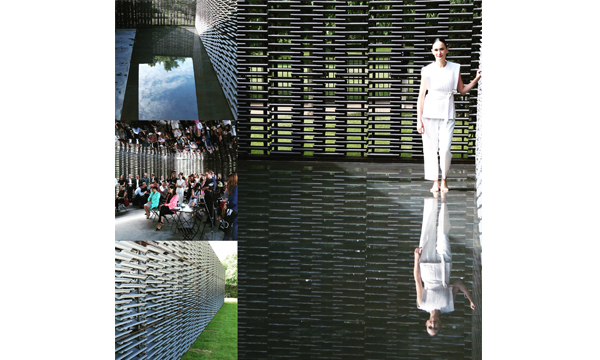
Escobedo’s Pavilion will take the form of an enclosed courtyard, comprised of two rectangular volumes positioned at an angle. While the outer walls will be aligned with the Serpentine Gallery’s eastern façade, the axis of the internal courtyard will align directly to the north. Internal courtyards are a common feature of Mexican domestic architecture, while the Pavilion’s pivoted axis refers to the Prime Meridian, which was established in 1851 at Greenwich and became the global standard marker of time and geographical distance.
British-made materials will be used in the Pavilion’s construction, chosen for their dark colours and textured surfaces. A celosia – a traditional breeze wall common to Mexican architecture – will here be composed of a lattice of cement roof tiles that diffuse the view out into the park, transforming it into a vibrant blur of greens and blues. Two reflecting elements will emphasise the movement of light and shadow inside the Pavilion over the course of the day. The curved underside of the canopy will be clad with mirrored panels, and a triangular pool cast into the Pavilion floor will trace its boundary directly beneath the edge of the roof, along the north axis of the Meridian. As the sun moves across the sky, reflected and refracted by these features, visitors may feel a heightened awareness of time spent in play, improvisation and contemplation over the summer months.
Escobedo’s prize-winning work in urban reactivation ranges from housing and community centres to hotels and galleries. In 2006, she founded her practice in Mexico City, with significant national projects including the Librería del Fondo Octavio Paz and an extension of La Tallera Siqueiros gallery in Cuernavaca. Her designs have featured at the Venice Architecture Biennale (2012 and 2014), the Lisbon Architecture Triennale (2013), and in San Francisco, London and New York. Recent projects include Stanford University’s Graduate School of Business and social housing projects in Guerrero and Saltillo, Mexico. She lectures nationally and internationally, and has won multiple awards and accolades.
Escobedo’s design enhances the Serpentine Pavilion’s reputation as a space of encounter and shared experience, following Francis Kéré’s acclaimed 2017 Pavilion, a bright and airy structure that was inspired by the tree at the heart of his hometown in Burkina Faso and visited by more than 200,000 people.
Frida Escobedo, architect of the 18th Serpentine Pavilion, said: “My design for the Serpentine Pavilion 2018 is a meeting of material and historical inspirations inseparable from the city of London itself and an idea which has been central to our practice from the beginning: the expression of time in architecture through inventive use of everyday materials and simple forms. For the Serpentine Pavilion, we have added the materials of light and shadow, reflection and refraction, turning the building into a timepiece that charts the passage of the day.”
Serpentine Galleries Artistic Director, Hans Ulrich Obrist and CEO, Yana Peel, said: “We are delighted to reveal the designs for Frida Escobedo’s Serpentine Pavilion, which promises to be a place both of deep reflection and dynamic encounter. With this bold interior, Frida draws history into the present and redefines the meaning of public space. We hope visitors of all ages will create their own experiences in the Pavilion this summer as we continue in our aim of bringing the urgency of art and architecture to the widest audiences.”
Richard Gnodde, Vice Chairman of the Goldman Sachs Group Inc. and CEO of Goldman Sachs International, said: “Over the past three years Goldman Sachs has been proud to support a diverse range of emerging young architects and we are delighted to continue our sponsorship this year. We are excited to see Frida Escobedo’s design come to life and we look forward to another engaging Pavilion and summer of activities at the Serpentine Galleries.”
David Glover, Technical Advisor said: "The Serpentine Pavilion is about providing the architect with the opportunity to use everyday materials in an innovative and creative way, challenging the user’s perception of architectural form and how buildings function. Frida has certainly delivered on this with her design, which generates a series of interlinked spaces that come alive through the clever use of light, shadow and reflection while maintaining a visual connectivity to the park. This Pavilion will delight and surprise its visitors.”
The annual Serpentine Pavilion Commission has become a global platform for architectural experimentation, presenting projects by some of the world's greatest architects, from Zaha Hadid in 2000 to Francis Kéré in 2017. The brief is to design a temporary Pavilion that is used as a community hub and café by day and a forum for learning, debate and entertainment at night. Each Pavilion is sited on the Serpentine Gallery's lawn for four months and the immediacy of the commission has made it a pioneering model worldwide.
The selection of an architect, someone who has consistently extended the boundaries of architectural practice but is yet to build in England, is led by the curatorial approach that guides all Serpentine programming: introducing the urgency of art and architecture to the widest possible audiences. The Serpentine Pavilion is consistently in the Top 10 most visited architecture exhibitions in the world. There is no budget for the project, which is realised entirely through sponsorship, in-kind support and the sale of the Pavilion.
The Serpentine Pavilion 2018 will once again be a platform for Park Nights, the Serpentine’s annual programme of experimental and interdisciplinary evenings on selected Fridays. Practitioners in the fields of art, architecture, music, film, theory and dance will be commissioned to create new, site-specific works in response to Escobedo’s design, offering unique ways of experiencing architecture and performance, sponsored by COS. Building on its 2017 success, Radical Kitchen also returns to the Pavilion on selected Thursday lunchtimes, inviting community groups, artists, activists, writers and architects to form connections through food. This programme of workshops, performances and talks will address geological time, empire and movements, inspired by the ideas behind Escobedo’s Pavilion design. The Architecture Family Pack and Programme, sponsored by COS, will give children and their families the chance to explore the Serpentine Pavilion from playful and original perspectives.
The Serpentine Summer Season continues with exhibitions of Tomma Abts at the Serpentine Sackler Gallery (7 June-9 September) and Christo & Jeanne Claude at the Serpentine Gallery (19 June-9 September).
The Serpentine Pavilion 2018 will be open every day from 10am to 6pm, excluding 18/19 June when it will close, re-opening at 1pm on 20 June.
Technical Advisor: David Glover
Engineering and all technical services: AECOM
Goldman Sachs is headline sponsor of the Serpentine Pavilion 2018
Press information and images can be downloaded from our press page here:
Nancy Groves, Esta dirección de correo electrónico está siendo protegida contra los robots de spam. Necesita tener JavaScript habilitado para poder verlo., + 44 (0)20 7298 1544
V Martin, Esta dirección de correo electrónico está siendo protegida contra los robots de spam. Necesita tener JavaScript habilitado para poder verlo., +44 (0)20 7298 1519
Press releases and images at serpentinegalleries.org/press
Serpentine Gallery, Kensington Gardens, London W2 3XA
Serpentine Sackler Gallery, West Carriage Drive, Kensington Gardens, London W2 2AR
NOTES TO EDITORS:
Frida Escobedo (b. 1979, Mexico City) founded her practice in 2006, after four years as co-director of the architectural firm Perro Rojo. Her award-winning work has focused mainly on reactivating urban spaces that are considered to be residual or forgotten. In 2004 she was awarded the Scholarship for Young Creators by the National Fund for Arts and Culture (FONCA) and in 2008 she was selected by Herzog & de Meuron as one of the architectural studios to participate in the Ordos 100 Project in Inner Mongolia, China. In 2009, she was a winner of the Young Architects Forum, organised by the Architectural League of New York. In 2013, she was selected as one of the three finalists for the Architecture programme at the Rolex Mentor and Protégé Arts Initiative and was nominated for the Arc Vision Prize for Women and the Iakov Chernikhov Prize. In 2014, she was selected as a finalist for the Designs of the Year at the Design Museum in London and was nominated for the Mies Crown Hall Americas Prize of the Illinois Institute of Technology. In 2014, she won the Ibero-American Biennale of Architecture and Urbanism Prize (IX BIAU) in Rosario, Argentina. In 2017, she received the Emerging Voices Award by the Architectural League of New York.
Goldman Sachs
The Goldman Sachs Group, Inc. is a leading global investment banking, securities and investment management firm that provides a wide range of financial services to a substantial and diversified client base that includes corporations, financial institutions, governments and individuals. Founded in 1869, the firm is based in New York and it maintains offices in all major financial centres around the world.
David Glover
David Glover brings a unique continuity and design expertise to the Serpentine Pavilion programme. Having worked on 14 of the past 17 Pavilions, David has a singular understanding of how to drive the Serpentine's brief to deliver exciting structures within six months of commission. David is key to the continued success of the programme, helping steer the entire team to bring creative, artful resolutions by promoting the use of innovative materials, detailing and construction techniques that push the boundaries of architecture.
AECOM
AECOM is built to deliver a better world. We design, build, finance and operate infrastructure assets for governments, businesses and organisations in more than 150 countries. As a fully integrated firm, we connect knowledge and experience across our global network of experts to help clients solve their most complex challenges. From high-performance buildings and infrastructure, to resilient communities and environments, to stable and secure nations, our work is transformative, differentiated and vital. See how we deliver what others can only imagine at aecom.com and @AECOM.
Stage One Creative Services Ltd.
Stage One are makers. Based in Yorkshire, their high-profile creative portfolio includes architectural pavilions, event environments, TV sets and stage engineering. This is the 10th year that Stage One have been commissioned to fabricate and construct the Serpentine Pavilion. Other notable projects include Wolfgang Buttress's Hive, now at Kew Gardens, and Thomas Heatherwick’s iconic 2012 Olympic cauldron. More information on the company and recent projects is presented at stageone.co.uk
Serpentine Pavilion History
Serpentine Pavilion architects to date are: Francis Kéré, 2017; Bjarke Ingels Group (BIG), 2016; selgascano, 2015; Smiljan Radić, 2014; Sou Fujimoto, 2013; Herzog & de Meuron and Ai Weiwei, 2012; Peter Zumthor, 2011; Jean Nouvel, 2010; Kazuyo Sejima and Ryue Nishizawa, SANAA, 2009; Frank Gehry, 2008; Olafur Eliasson and Kjetil Thorsen, 2007; Rem Koolhaas and Cecil Balmond, with Arup, 2006; Álvaro Siza and Eduardo Souto de Moura with Cecil Balmond, Arup, 2005; MVRDV with Arup, 2004 (un-realised); Oscar Niemeyer, 2003; Toyo Ito and Cecil Balmond - with Arup, 2002; Daniel Libeskind with Arup, 2001; and Zaha Hadid, who designed the inaugural Pavilion in 2000. Serpentine Summer Houses architects in 2016 were: Kunlé Adeyemi – NLÉ, Barkow Leibinger, Yona Friedman, and Asif Khan.
Detalles
Concluyen las negociaciones para un nuevo acuerdo integral entre México y la Unión Europea
Comunicado conjunto SRE-SE.- Por medio de las Secretarías de Relaciones Exteriores y de Economía, el gobierno de México anuncia la conclusión exitosa de las negociaciones de un nuevo acuerdo global con la Unión Europea que incluye aspectos políticos, económicos y de cooperación, que permitirán fortalecer el diálogo político, incrementar los flujos comerciales y de inversión, así como elevar la cooperación técnica y científica para beneficio de ambas sociedades.
Concluyen las negociaciones para un nuevo acuerdo integral entre México Y la Unión Europea
Autor Secretaría de Relaciones Exteriores 21 de abril de 2018 Por medio de las Secretarías de Relaciones Exteriores y de Economía, el gobierno de México anuncia la conclusión exitosa de las negociaciones de un nuevo acuerdo global con la Unión Europea que incluye aspectos políticos, económicos y de cooperación, que permitirán fortalecer el diálogo político, incrementar los flujos comerciales y de inversión, así como elevar la cooperación técnica y científica para beneficio de ambas sociedades.
Al igual que en 1997, cuando se concluyó el Acuerdo de Asociación Económica, Concertación Política y Cooperación (conocido como Acuerdo Global, en vigor desde 2000), México y la Unión Europea escriben una nueva página en su historia con el acuerdo más avanzado en su tipo, el cual, además de incluir un sólido apartado que refuerza el vínculo comercial y económico al incluir nuevas disciplinas para fomentar el intercambio comercial y de inversión, también incluye áreas políticas y de cooperación, que permitirán tanto a México como a la Unión Europea desempeñarse como actores globales en beneficio de sus sociedades.
México y la Unión Europea comparten valores como la promoción de la democracia, la defensa de los derechos humanos, el respeto al Estado de derecho, el libre comercio y el multilateralismo.
El pilar comercial del nuevo Tratado profundiza los beneficios del comercio entre México y la Unión Europea, particularmente en el sector agroalimentario, en donde se eliminarán los aranceles a productos mexicanos como jugo de naranja, el atún, la miel, el jarabe de agave, la ovoalbumina y frutas y vegetales, entre otros. Adicionalmente, se logró proteger a los productos sensibles, como manzanas, duraznos y productos lácteos. Estas acciones representaran beneficios para los consumidores, a la vez que promoverán la diversificación de nuestras exportaciones.
Se amplía también la cobertura en el comercio de servicios, al incorporar telecomunicaciones, entrada temporal de personas y servicios relacionados con la economía digital; y se refuerzan las disposiciones para la protección de las inversiones, incluyendo un moderno mecanismo de solución de controversias. Desde un año antes de la entrada en vigor del TLCUEM (1999), el comercio entre México y la Unión Europea se cuadruplicó. El bloque europeo contribuye con el 38% de la IED que recibe México, con flujos que rebasan los 184,636 mil MD entre 1999 y segundo 2017.
Con la conclusión de este nuevo acuerdo, México y la Unión Europea envían un fuerte mensaje al mundo sobre la importancia de mantener los mercados abiertos, trabajar conjuntamente por la vía multilateral para enfrentar desafíos globales y de cooperar en beneficio de las causas de la humanidad.